
Automated Multi-Axis Laser Welding for Precision Manufacturing
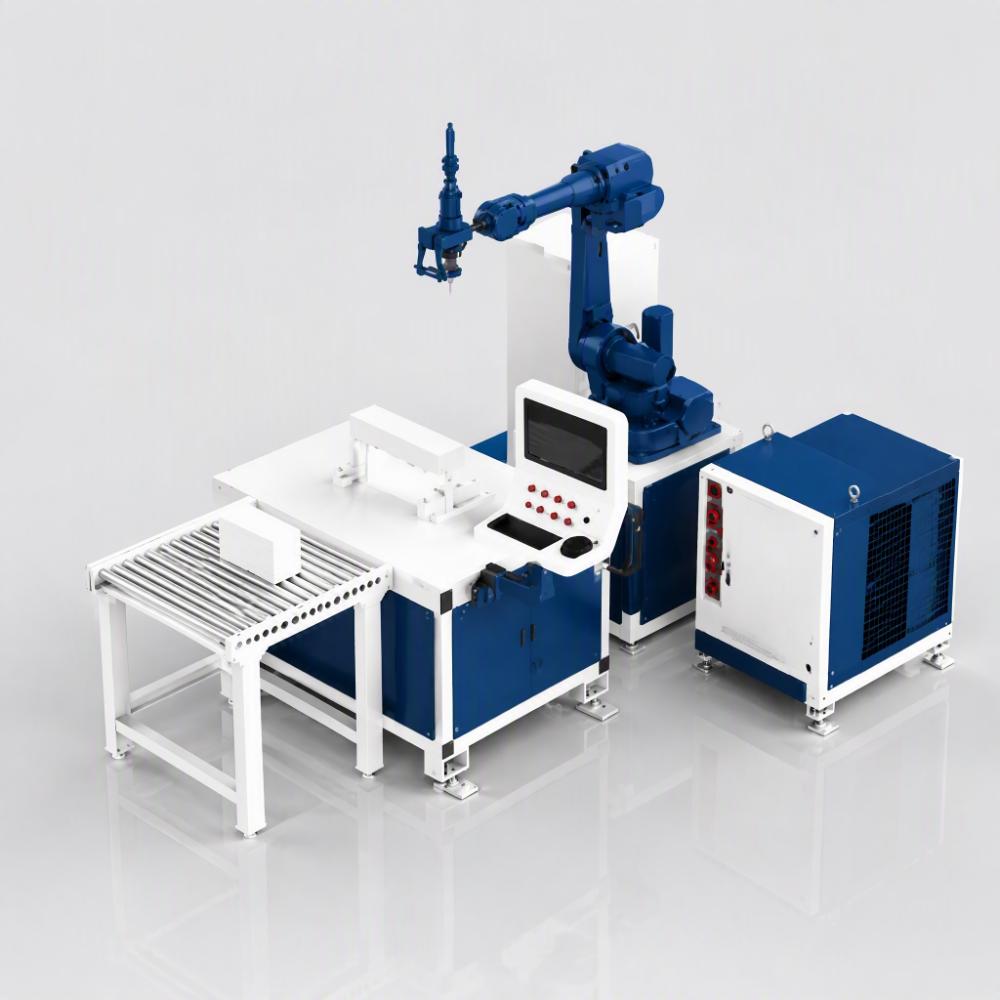
The JUYI Robotic Laser Welding Machine is an advanced robotic laser welding system designed for high-efficiency production, precision metal joining, and flexible automated manufacturing.
By integrating a high-performance laser welding source with an industrial robot, precision welding head, programmable motion control, and customized fixtures, the system enables accurate and repeatable welding of complex metal components.
Unlike conventional fixed-position welding machines, the robotic configuration provides flexible multi-axis movement and programmable welding paths, making it suitable for products with multiple welding positions, complex geometries, curved surfaces, and three-dimensional structures.
Depending on the application, JUYI can configure the system with Continuous Wave (CW) Fiber Laser, QCW Fiber Laser, Pulsed Nd Laser, or other suitable laser sources according to the material, product structure, thickness, welding requirements, and production volume.
The system can also be integrated with automatic feeding, positioning, clamping, rotary tables, CCD vision systems, inspection systems, and robotic material handling to create a complete automated welding production solution.
How Does the Robotic Laser Welding Machine Work?
The JUYI robotic laser welding system combines robotic movement with precise laser energy delivery to complete programmed welding operations.
A typical production workflow is:
Loading → Positioning → Clamping → Robotic Movement → Laser Welding → Inspection → Unloading
The workpiece is first positioned using precision fixtures or optional vision-assisted positioning systems.
The industrial robot then moves the laser welding head along the programmed welding path. The robot can approach the workpiece from different angles, allowing the system to perform welding on multiple surfaces and positions.
The laser beam delivers concentrated energy to the joint area, creating a controlled molten pool and forming a precise welded joint as the robot follows the programmed path.
For automated production, additional equipment can be integrated, including:
- Automatic feeding systems
- Automatic loading and unloading
- Rotary tables
- Positioners
- CCD vision systems
- Automatic fixtures
- Welding inspection systems
- Conveyor systems
- Production data monitoring
- MES integration
This modular architecture allows the robotic welding cell to be configured according to the customer’s product and production requirements.
Key Advantages
Robotic Multi-Axis Welding
The robotic configuration provides flexible multi-axis movement, allowing the welding head to access different welding positions and complex product geometries.
This is particularly useful for:
- Multi-side welding
- Complex assemblies
- Curved components
- Three-dimensional structures
- Multiple welding positions
- Difficult-to-access joints
The robot can follow programmed welding paths with high repeatability, making it suitable for both repetitive production and complex component welding.
High Welding Repeatability
Robotic motion control combined with programmable laser parameters provides consistent welding conditions from one workpiece to the next.
The system helps maintain:
- Consistent welding position
- Stable welding speed
- Repeatable welding paths
- Controlled laser parameters
- Consistent weld appearance
This is especially important for high-volume production where product consistency is critical.
Flexible Welding Paths
The robotic system can be programmed according to the geometry and welding requirements of different products.
It can support:
- Single-point welding
- Multi-point welding
- Continuous seam welding
- Circular welding
- Linear welding
- Curved-path welding
- Multi-side welding
- Customized welding paths
When product designs change, welding programs can be modified without fundamentally changing the machine structure.
Suitable for Complex 3D Components
One of the major advantages of robotic laser welding is its ability to work with complex three-dimensional components.
The robot can change the position and angle of the welding head during the welding process, helping maintain a suitable welding orientation for different joints.
This makes the system suitable for:
- Complex metal assemblies
- Three-dimensional components
- Irregular structures
- Curved products
- Multi-angle welding
- Components with multiple welding surfaces
High Production Efficiency
Robotic movement and programmable welding sequences reduce unnecessary manual positioning and handling.
For repetitive production, the system can automatically repeat predefined welding programs, helping reduce cycle time and improve production capacity.
Optional automatic loading and unloading systems can further reduce operator involvement.
Reduced Manual Labor
The robotic welding cell can automate repetitive welding operations and material handling processes.
Depending on the configuration, one operator can monitor the robotic welding system rather than manually welding every individual component.
This can help manufacturers reduce:
- Manual welding operations
- Repetitive labor
- Operator dependency
- Positioning errors
- Production variability
Easy Integration with Automation
The robotic welding system can operate as a standalone welding cell or be integrated into a larger automated production line.
Optional systems include:
- Automatic loading
- Automatic feeding
- Automatic positioning
- Automatic clamping
- Rotary indexing
- Robotic material handling
- CCD vision positioning
- Automatic inspection
- Conveyor systems
- Production monitoring
- MES integration
This allows JUYI to develop robotic welding systems ranging from semi-automated cells to fully automated production lines.
Laser Welding Technology
The laser welding process uses a concentrated laser beam to deliver controlled energy directly to the joint area.
The laser rapidly melts the metal and forms a controlled weld pool. As the laser moves along the programmed welding path, the molten metal solidifies to form a strong and precise joint.
JUYI can configure different laser technologies according to the material, thickness, product structure, and welding requirements.
Continuous Wave Fiber Laser
Continuous Wave (CW) fiber lasers are suitable for high-speed continuous welding applications.
Typical applications include:
- Sheet metal components
- Tubes
- Frames
- Housings
- Structural components
- Metal assemblies
CW fiber lasers are particularly suitable for applications requiring continuous seam welding and high production efficiency.
QCW Fiber Laser
QCW fiber lasers combine high peak power with controlled heat input, making them suitable for precision welding applications.
Typical applications include:
- Copper components
- Electrical components
- Battery parts
- Conductive components
- Small metal components
- Precision assemblies
QCW technology can be selected when the application requires high peak power while maintaining controlled thermal input.
Pulsed Nd Laser
Pulsed Nd laser technology is suitable for precision welding and applications requiring controlled pulsed laser energy.
Typical applications include:
- Small components
- Precision welding
- Jewelry components
- Repair applications
- Fine metal assemblies
The appropriate laser source is selected according to the specific welding application.
Robotic Laser Welding Applications
The JUYI Robotic Laser Welding Machine can be configured for a wide range of automated welding processes.
Multi-Point Welding
Suitable for products requiring multiple welding points in a predefined sequence.
The robot automatically positions the welding head and completes the programmed welding points.
Typical applications include:
- Brackets
- Connectors
- Hardware components
- Metal assemblies
- Structural components
Continuous Seam Welding
Suitable for products requiring continuous or overlapping welds.
Typical applications include:
- Metal housings
- Enclosures
- Tubes
- Containers
- Sheet metal components
- Structural assemblies
Circular Welding
The robotic welding system can be combined with rotary fixtures or rotary positioners for circumferential welding.
Typical applications include:
- Tubes
- Cylindrical components
- Circular joints
- Ring-shaped components
- Rotational assemblies
Complex Multi-Angle Welding
The robot can change the welding head position and angle to access multiple surfaces of a component.
This is suitable for:
- Three-dimensional assemblies
- Complex brackets
- Automotive components
- Machinery components
- Industrial structures
- Irregular metal parts
Repetitive Component Welding
Robotic laser welding is particularly suitable for high-volume production of identical components.
Once the welding program and fixture are validated, the robot can repeatedly perform the same welding sequence with consistent positioning and motion.
Suitable Materials
Depending on the selected laser source and process configuration, the JUYI Robotic Laser Welding Machine can be used for various metal materials, including:
- Stainless steel
- Carbon steel
- Mild steel
- Aluminum
- Copper
- Brass
- Nickel alloys
- Titanium
- Precious metals
- Other compatible metal alloys
The appropriate laser power, welding speed, focal position, shielding gas, and welding parameters should be selected according to the material type, thickness, joint design, and production requirements.
Typical Applications
The JUYI Robotic Laser Welding Machine can be customized for:
- Metal component welding
- Sheet metal welding
- Tube welding
- Structural component welding
- Electrical component welding
- Battery component welding
- Copper component welding
- Stainless steel welding
- Hardware welding
- Precision component assembly
- Automotive component welding
- Industrial equipment welding
- Jewelry component welding
Suitable Industries
Automotive Manufacturing
For automated welding of brackets, structural components, housings, connectors, and other automotive parts.
Robotic movement is particularly useful for components requiring multiple welding positions and repeatable production.
Battery & New Energy
For welding applications involving battery components, terminals, tabs, busbars, housings, and other precision electrical connections.
QCW fiber laser configurations can be considered for applications involving copper and other highly reflective materials.
Electrical & Electronics
For terminals, connectors, relays, electrical components, housings, and conductive metal parts.
Robotic positioning can help automate repetitive welding operations and maintain consistent welding quality.
Metal Fabrication
For sheet metal components, enclosures, frames, cabinets, tubes, and structural assemblies.
The robotic configuration provides greater flexibility for products with multiple welding positions.
Hardware Manufacturing
For repetitive production of metal hardware, fittings, brackets, connectors, and precision components.
Industrial Manufacturing
For machinery components, industrial equipment, metal assemblies, frames, and customized products.
Jewelry Manufacturing
For precision welding of jewelry components and repetitive small-part production.
For jewelry applications, suitable laser sources and precision fixtures can be configured according to the product size, material, and welding requirements.
Automation Features
The exact automation configuration can be customized according to the customer’s production process.
Possible functions include:
- Industrial robot
- Automatic loading
- Automatic feeding
- Automatic positioning
- Automatic clamping
- Robotic laser welding
- Multi-axis robotic movement
- Rotary indexing
- Rotary positioner
- CCD vision positioning
- Automatic inspection
- Automatic unloading
- Production data monitoring
- MES integration
The modular architecture allows JUYI to configure the robotic welding cell according to the product geometry, production volume, cycle time, and automation requirements.
Why Choose JUYI Robotic Laser Welding Machine?
- Robotic multi-axis welding
- Programmable welding paths
- High welding repeatability
- Flexible multi-angle welding
- Suitable for complex 3D components
- Consistent welding quality
- High production efficiency
- Reduced manual welding
- Flexible laser source configuration
- Optional CCD vision positioning
- Rotary positioner integration
- Automatic loading and unloading options
- Customized fixtures and tooling
- Production-line integration available
- Suitable for high-volume manufacturing
Customized Robotic Laser Welding Solutions
Every robotic welding application is different.
Product dimensions, material, thickness, welding positions, joint design, cycle time, production volume, and automation requirements all affect the final equipment configuration.
JUYI provides customized robotic laser welding solutions based on the customer’s actual production requirements.
A typical solution may include:
Laser Source + Welding Head + Industrial Robot + Precision Fixture + Motion System + Rotary Positioner + Vision System + Automatic Handling + Inspection
Depending on the production requirements, JUYI can provide configurations ranging from a standalone robotic welding cell to a fully automated welding production line.
When Should You Choose a Robotic Laser Welding Machine?
A robotic laser welding system is particularly suitable when your production requires:
- High production volume
- Repetitive welding operations
- Multiple welding positions
- Complex welding paths
- Multi-angle welding
- Three-dimensional component welding
- High welding repeatability
- Consistent product quality
- Reduced manual labor
- Short cycle times
- Automated production
- Production traceability
For simple single-position welding applications, a conventional laser welding machine may be more economical. For complex, repetitive, multi-position, or high-volume welding, a robotic laser welding system can provide greater flexibility and automation potential.
Get a Customized Robotic Laser Welding Solution
Send JUYI your product drawings, material, thickness, welding positions, welding requirements, production volume, and target cycle time.
Our engineering team can evaluate the welding process and recommend the appropriate laser source, welding head, industrial robot, fixtures, rotary positioner, vision system, and automation configuration.
From a standalone robotic welding cell to a complete automated welding production line, JUYI can develop a customized solution based on your manufacturing process.

Reviews
There are no reviews yet.